
Key Takeaways
Cleaning every 3–6 months is the standard range — the right interval depends on usage hours and air quality, not just time elapsed.
The Gigit AC Frequency Matrix maps your usage pattern to a specific recommended cleaning interval.
Five warning signs indicate your AC needs cleaning immediately, regardless of schedule — musty smell, reduced cooling, visible dust buildup, increased electricity bills, and unusual sounds.
Cleaning too often is not harmful to the unit; under-cleaning is what causes damage and health risks.
How Often Should You Clean Your AC?
The most common answer you will find — clean once or twice a year — reflects minimum maintenance, not optimal maintenance. In Thailand's climate, with high ambient humidity, urban particulate matter, and the length of time most households run their AC, once a year is rarely enough.
The correct answer is not a single number. It is a combination of two variables: daily usage hours and the air quality of your environment. A unit in a busy Bangkok street-level condo accumulates dust and particulates faster than one in a quieter residential neighbourhood. Use the matrix in the next section to find your interval.
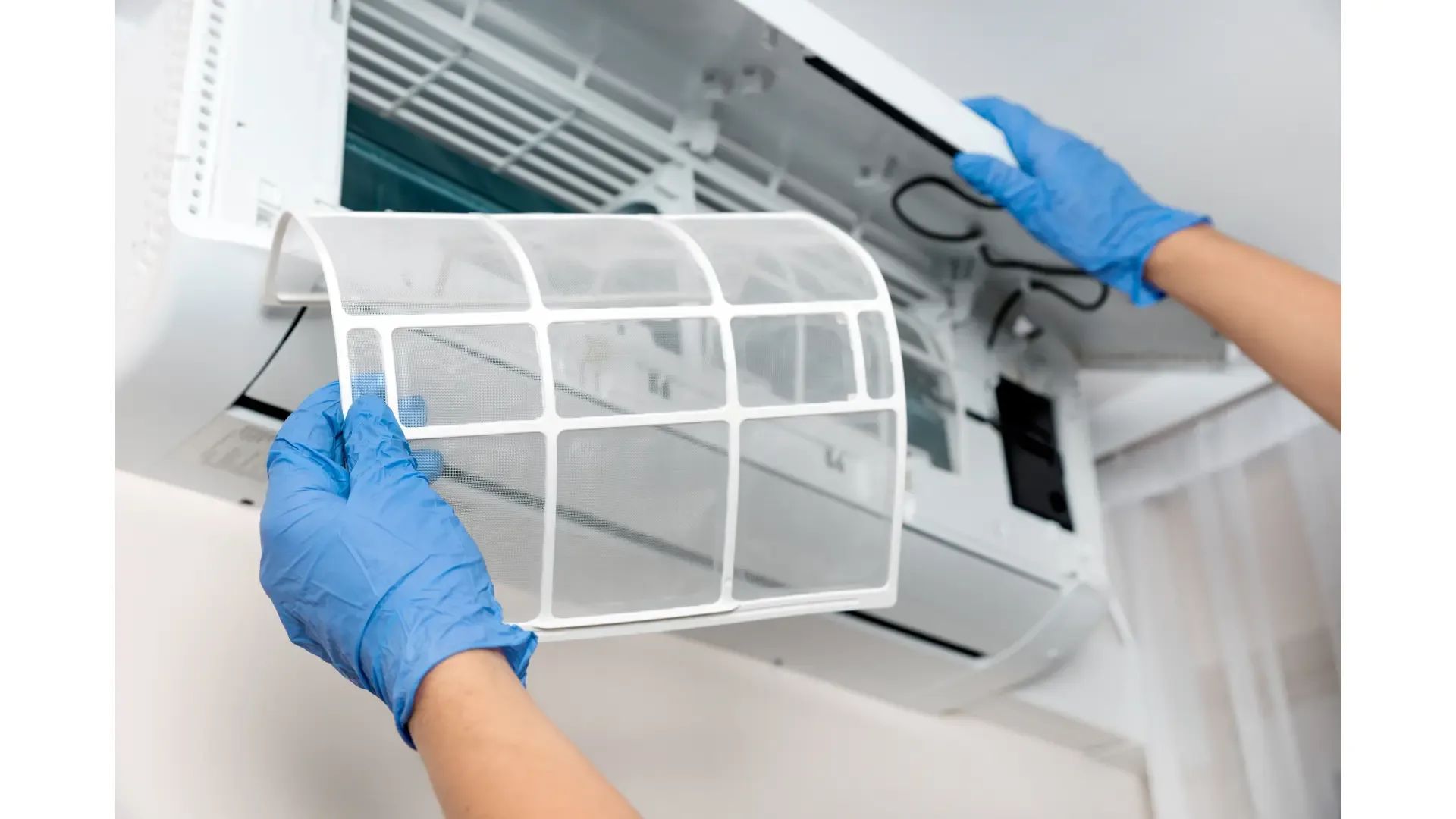
What every unit shares, regardless of frequency: the filter should be rinsed by the user every 2–4 weeks. This is not the same as a full clean — it simply removes surface dust from the filter screen and takes about five minutes. A full professional clean, covering both the indoor evaporator coil and the outdoor condenser, is what this article addresses.
The gigit AC Frequency Matrix
Find your usage pattern in the left column, then match it to your environment type on the right.
Daily usage | Clean environment (suburb, low traffic, low dust) | Mixed environment (mid-city, some traffic) | High-particulate environment (busy Bangkok street, near construction, or high humidity) |
|---|---|---|---|
Light (under 4 hrs/day) | Every 6 months | Every 5 months | Every 4 months |
Moderate (4–8 hrs/day) | Every 5 months | Every 4 months | Every 3 months |
Heavy (8+ hrs/day) | Every 4 months | Every 3 months | Every 3 months |
Continuous (near 24 hrs/day) | Every 3 months | Every 3 months | Every 2–3 months |
These intervals apply to wall-mounted residential units. Cassette and ceiling units in commercial settings may require more frequent service due to higher airflow volume and harder-to-access components.
Most Bangkok households running their AC 6–8 hours a day in a mid-city condo fall into the moderate usage / mixed environment cell: every 4 months, or roughly three times a year. This is meaningfully more frequent than the "once or twice a year" advice that circulates online, and it reflects the reality of Bangkok's air quality, not a generic global recommendation.
Book a verified AC cleaning technician through gigit.
5 Signs Your AC Needs Cleaning Now
Musty or stale smell when the unit starts. This is almost always mould or bacteria growing on the evaporator coil or in the drain tray. The smell circulates through the room air every time the fan runs. This is a health issue, not just an inconvenience.
Reduced cooling: the room takes longer to reach your set temperature. A clogged evaporator coil cannot transfer heat efficiently. The unit runs longer to achieve the same result, which also increases your electricity consumption.
Visible dust buildup around the vents or on the filter. If you can see it from the floor, the internal components are in a worse state. A filter clogged enough to be visibly grey is restricting airflow and forcing the fan motor to work harder.
Unexplained increase in your electricity bill. A dirty AC can consume 10–15% more electricity than a clean one running at the same settings. If your usage habits have not changed but your bill has risen, the unit is likely working inefficiently.
Unusual sounds — rattling, gurgling, or a high-pitched whine. Rattling can indicate debris in the blower fan. Gurgling often signals a blocked drain pipe. A high-pitched whine from the outdoor unit may indicate the condenser fins are clogged and the compressor is overworking.
Any one of these signs warrants a clean, even if you serviced the unit two months ago.
Can You Clean Your AC Too Often?
No — cleaning your AC more frequently than the matrix recommends does not damage the unit. The concern sometimes raised by Thai homeowners (reflected in Pantip discussions) is that frequent cleaning will reduce the AC's lifespan or cause leaks. This is not accurate.
What can cause damage is poor technique during cleaning — using excessive water pressure on delicate fins, failing to dry the unit adequately before powering it back on, or using harsh chemical cleaners not designed for AC coils. These are technician-quality issues, not frequency issues. A properly executed clean every two months causes no harm.
The practical constraint on frequency is cost and scheduling, not unit health. If you use your AC heavily and live in a high-particulate area, cleaning every two to three months is a reasonable and harmless choice.
What Happens When You Leave It Too Long?
In the first stage (months 3–6 of no cleaning), airflow restriction begins as the filter and evaporator coil accumulate dust. The unit starts using more electricity to compensate, and cooling performance drops noticeably.
By months 6–12, mould and bacteria begin to colonise the damp evaporator coil and drain tray. Bangkok's humidity creates ideal conditions for this. The musty smell is the visible symptom; the invisible one is airborne mould spores circulating through your room.
Beyond 12 months, the outdoor condenser coil is typically significantly clogged. The compressor operates under sustained thermal stress. At this stage, a single full clean may not be sufficient to restore normal function; the technician may also need to check refrigerant pressure and, in some cases, replace the drain tray or clean the drain pipe with a specialist tool.
The cost of a full clean starts at ฿600 for a wall-mounted unit, which is substantially lower than compressor repair or replacement, which typically starts at ฿3,000–8,000 depending on the unit. Consistent cleaning is maintenance cost avoidance, not an optional extra.
How to Check the Technician Did a Complete Job
A full AC clean takes 60–90 minutes for a standard wall-mounted unit. If a technician finishes in under 30 minutes, only part of the service was completed. Use these four checks immediately after the technician leaves.
Step 1: Turn the unit on and check the airflow. The output should feel noticeably stronger and fresher than before the clean. If there is no perceptible difference, the evaporator coil may not have been cleaned properly.
Step 2: Check for a musty smell. A unit that had a smell before the clean should have no smell after. If the smell persists, the drain tray or coil was not adequately cleaned.
Step 3: Check the drain pipe is clear. Pour a small amount of water into the drain tray (or ask the technician to do so before leaving) and confirm the water drains freely. A blocked drain pipe will cause water to drip from the indoor unit within a day or two of use.
Step 4: Check the outdoor unit. Walk to the outdoor condenser after the job. The fins should be visibly cleaner than before. If the outdoor unit was not touched, the job was incomplete — the condenser is half the system.
Browse verified AC cleaning technicians and book through the gigit app.